Take Action: End cruel fur farming worldwide.
Sign the petition to end the cruel dog meat trade.
Take Action: End cruel fur farming worldwide.
Jackie Kreutzer
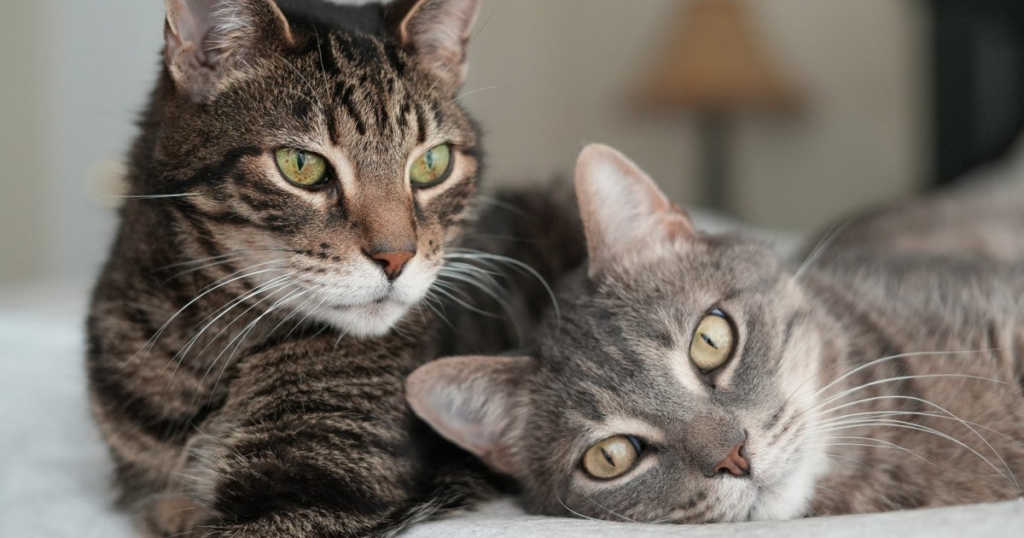
Cats are territorial, so two or more cats don’t always get along with each other at first. Here are some tips to help keep the peace between your pets.
When we think of “aggression,” we may think of a variety of motivations and impulses deriving from our own experience as humans. Fortunately, aggression in cats is easier to make sense of and typically derives from two impulses: fear and mistrust. These are the most likely scenarios to cause fear and mistrust among cats:
The good news is that cat owners can reduce their cats’ fear and mistrust of each other and increase positive feelings among the cats in the household.
But before moving to the specifics, let’s address three words that you’ve probably heard before: “Cats are territorial.” What does this actually mean? Well, let’s start with dogs. Dogs are scavengers by nature—they go where the food is—and while they may guard certain objects or spaces, they’re not territorial in the way cats are.
Cats, unlike dogs, are hunters by nature and, also unlike dogs, they don’t wander from their territory. To go outside their territory puts cats at risk of encountering other cats and animals who they’re competing with for food and who may potentially harm them. On the other hand, a new cat entering the resident cat’s territory is likely to be perceived as a potential threat.
Related to being territorial is the need for cats to feel safe and secure in their territory—knowing that they’re not in danger and that all resources they need to survive and thrive are readily available. A cat who doesn’t feel safe and secure in their territory will hide or may show aggression in an attempt to keep potential danger (other cats) away from them.
Sign up to receive our exclusive e-book full of important information about keeping your cat healthy and happy.
With these ideas in mind, here are the steps to resolve—or, better yet—avoid fighting between cats:
Spaying and neutering greatly reduces aggression in cats. More to the point, because of their impulse to be territorial, it’s often impossible to resolve aggression among cats if one or more cats is intact.
Slowly means at the pace of the cat who is showing the most fear and mistrust. This may be the new cat or the resident cat(s). This pace may be a matter of days, weeks or months—it’s up to the cat. The role of the cat owner is to provide an environment that increases the likelihood of the cat feeling safe and secure in the new territory or with the other cat. It’s important to understand that cats don’t “work things out.” If cats aren’t getting along, the fighting will only increase unless you take steps to properly reintroduce them.
Introducing Your New Cat to Other Pets
A resource is anything the cat needs or wants. For example: litter boxes, scratching posts, food/water bowls, human attention and playtime, resting spaces, hiding spaces and toys.
One cat (typically the younger, active cat) chasing the other cat in play is often perceived as aggression when it’s actually a result of the cat not having their daily energy needs met. Cats have much more energy to expend than most of us realize. If we’re not proactive in meeting our cats’ energy needs, the more active cat may chase the less active one (fun for the active cat, but not very fun for the less active one who just wants to be left alone). Play is also a great way to reduce stress in cats. When cats are playing, they think they’re hunting, and play can boost a cat’s confidence while also expending physical and mental energy.
To change the mindset of cats who fear/mistrust each other, give them a reason to like each other. What does this mean for cats? Providing them with something they love when the other cat is around or when they see the other cat. Typically, this involves giving the cats food or a treat! Playtime, as well as grooming (assuming your cat likes to be brushed), can also lead to positive associations. It’s important to note that this is a process which may take a long time and requires consistency.
Cats are very sensitive to changes in their territory, and if they feel less safe and secure in their home, this may indirectly cause tensions or fighting among the cats. For example, loud construction noises outside or inside the home, change in routine, or the introduction of new people or animals into the home (to name only a few possible stressors). When possible, take action to minimize the impact of these changes.
Ill or injured cats don’t feel safe and secure, and this can create tensions and fighting in a multi-cat household.
This is particularly important with a specific type of aggression called “redirected aggression.” This involves a single event that frightens one or more cats and, in this moment of fear, one attacks the other. A common example is if two cats are sitting on a windowsill and an outdoor cat appears and frightens the cats. A sudden loud noise or a sudden injury can also cause this behavior. It’s extremely important that the cats remain entirely separated until both cats are acting like their normal selves, and then a slow reintroduction is needed. This process can be a challenge and is best done under the guidance of a professional.
Not all “aggressive” behaviors are the same. In fact, some cat behaviors often assumed to be aggressive are not.
A cat’s way of saying “leave me alone.” A cat who hisses isn’t feeling safe and secure in that moment. This is a defensive vocalization. A hissing cat will likely only go on the offensive and initiate fighting if they continue to feel threatened and feel they have no other choice. When introducing cats, consistent hissing is the signal to the cat owner to slow the introduction process.
Another defensive vocalization that indicates the cat is feeling very unsafe and insecure.
A defensive behavior in which the cat is trying to create distance between themself and the other animal or person.
This behavior is very much based on the context. While chasing may be a result of territorial issues, sometimes it’s playful behavior (or at least perceived as play by the cat doing the chasing).
This behavior is a last resort for cats and is a result of either significant territorial issues and/or one or more cats feeling very unsafe and experiencing a great deal of stress. Contact a professional cat behavior expert if your cats are fighting to the point of physically harming each other.
Start saving lives by making a one-time gift today. Or help animals all year long with a monthly contribution.
Jean Chung/For Humane World for Animals
© 2025 Humane World for Animals is registered as a 501(c)(3) nonprofit organization. Contributions to the Humane World for Animals are tax-deductible to the extent permitted by law. The Humane World for Animals tax identification number is 53-0225390.